

Who Is Mike Wolfe Beyond the TV Screen?
Most people know Mike Wolfe as the enthusiastic, sharp-eyed host of American Pickers — the History Channel show where he and his crew roll through rural America hunting for buried treasure in barns, garages, and forgotten farmsteads. He’s charming on screen, quick with a handshake, and almost supernaturally good at spotting a rare motorcycle gas tank beneath a pile of old lumber.
But if you stop there, you’ve only read the cover.
The real Mike Wolfe is a preservationist, a community builder, and a storyteller whose work extends far beyond what any camera can capture. The Mike Wolfe passion project isn’t a side hustle or a PR stunt — it’s a deeply personal, decades-long commitment to making sure that the history embedded in America’s small towns doesn’t quietly disappear.
This article takes a close look at what that mission actually involves, where it came from, and why it resonates with so many people who believe that history is worth fighting for.
What Is the Mike Wolfe Passion Project, Really?
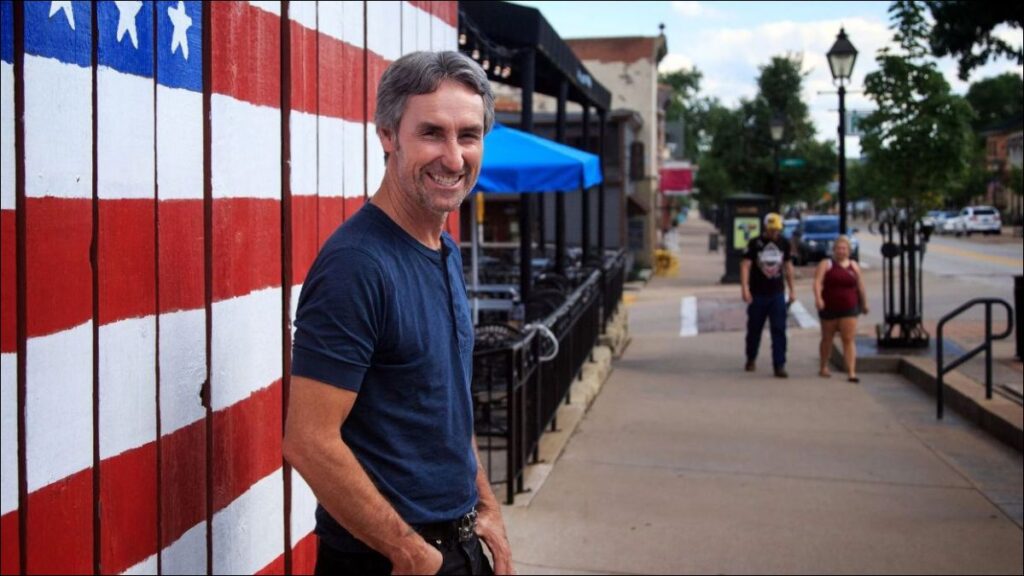
At its core, the Mike Wolfe passion project is about preservation — but not just in the museum-glass sense of the word. Wolfe isn’t interested in locking things behind velvet ropes. He wants to breathe new life into them.
His mission operates on several interconnected levels:
- Architectural restoration — buying and rehabilitating neglected historic buildings so they become functional, community-serving spaces again
- Cultural storytelling — documenting the people, trades, and traditions that built America, through digital content, documentary work, and his blog
- Economic revitalization — transforming restored structures into businesses that generate local employment and attract visitors
- Artisan and craft promotion — spotlighting makers, craftspeople, and small businesses that carry old-world skills into the modern era
What makes the Mike Wolfe passion project distinctive is that it treats history as something living. Not a relic. Not a museum exhibit. A resource — one that, when properly honored, can actually strengthen communities in the present.
From Iowa Alleys to American Icons: The Origin Story
To understand why Mike Wolfe cares so deeply about forgotten places, you have to go back to a kid on a bicycle in Iowa.
Long before American Pickers premiered in 2010, young Mike was already developing the instinct that would define his life’s work. He’d pedal through alleys and backyards, eyes scanning for anything that other people had thrown aside. A rusted sign. A worn-down bicycle frame. A glass bottle with the name of a general store that no longer existed.
What struck him wasn’t just the objects themselves — it was the stories attached to them. Every discarded item was evidence that something real had happened here: that someone had lived, worked, dreamed, and built something. That mattered to him in a way he couldn’t fully articulate as a child but would spend his adult life acting on.
As his collection grew, so did his awareness of a larger problem. The towns these objects came from were fading. Main Streets were emptying out. Historic storefronts were boarded up or torn down. The physical infrastructure of American community life was being quietly erased, and with it, the stories that gave those places meaning.
That’s where the seeds of the Mike Wolfe passion project were really planted — not on television, but in the realization that saving one object wasn’t enough. He needed to save the places those objects came from.
Columbia, Tennessee: Where the Vision Comes to Life
If you want to see the Mike Wolfe passion project in its most tangible form, point your GPS toward Columbia, Tennessee — a town roughly 45 miles south of Nashville, historically known as “Muletown” for its role as a mule-trading center in the 19th century.
Columbia had, like many mid-sized Southern towns, experienced decades of economic drift. Storefronts sat empty. Historic buildings deteriorated. The kind of energy that once defined the downtown had dispersed to strip malls and suburban corridors.
Wolfe saw something different. He saw bones worth restoring.
His investments in Columbia have been transformative. Most notably, he spearheaded the development of Columbia Motor Alley — a revitalized district anchored by vintage motorcycle culture, artisan businesses, and carefully restored architecture. The project didn’t just fix up old buildings; it created destinations. Restaurants, shops, and gathering spaces that draw visitors and give locals a reason to stay.
The Nashville Big Back Yard Initiative
Beyond Columbia, Wolfe has been a vocal champion of what’s sometimes called Nashville’s Big Back Yard — the surrounding communities of Middle Tennessee that often get overshadowed by the city’s explosive growth.
The idea is straightforward but powerful: redirect some of the energy and investment flowing into Nashville toward the smaller towns nearby. Places like Leiper’s Fork, Franklin, and Columbia have their own authentic identities, their own histories, and their own potential — if someone is willing to show up and do the work.
Wolfe has done exactly that. His presence in these communities hasn’t just brought money; it’s brought attention, credibility, and a framework for thinking about restoration as economic development.
The Two Lanes Platform: Storytelling as Preservation
One of the less-covered aspects of the Mike Wolfe passion project is his digital platform, Two Lanes — part travel blog, part online shop, part living archive of American culture.
On Two Lanes, Wolfe posts the kind of content you don’t find on mainstream platforms. Grainy 35mm photographs of forgotten roadside motels. Interviews with fourth-generation saddlemakers in Texas. Short films about ceramic artists in Ohio who learned their craft from a grandparent who learned it from theirs.
The shop side of Two Lanes is equally intentional. Limited-run merchandise — hand-stitched leather tool rolls, enamel mugs made by artisan potters, objects that are themselves small acts of preservation. Every product connects back to a maker, a tradition, and a story.
What Wolfe understands, perhaps better than most, is that preservation isn’t only physical. The stories, the skills, the knowledge embedded in craftsmanship — these are just as endangered as old buildings. Two Lanes is his effort to document them before they disappear.
It’s also, quietly, one of the most effective parts of the Mike Wolfe passion project in terms of reach. The platform reportedly saw a 220% traffic increase over a recent six-month stretch, which suggests a genuine hunger for the slow, analog, human-centered storytelling it delivers.
Americana Music, Motorcycles, and More
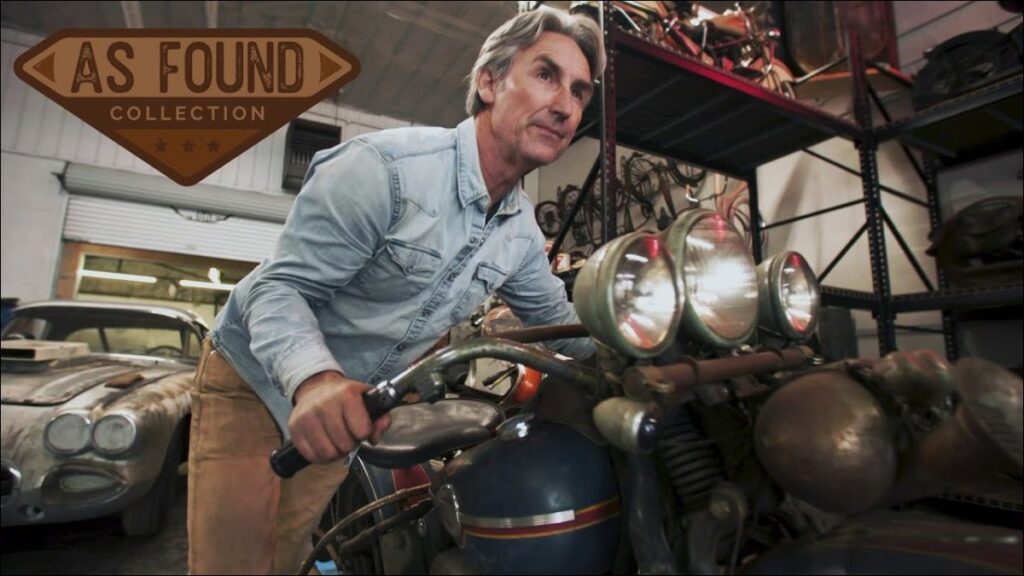
Any honest account of the Mike Wolfe passion project has to include two of its most personal dimensions: Americana music and vintage motorcycles.
A Deep Love for Americana
Wolfe’s connection to American roots music isn’t incidental — it’s philosophical. He sees Americana as another form of living history, a tradition that carries the emotional texture of working-class American life in a way that documents and photographs can’t fully replicate.
He has used his platform to promote artists and labels operating in this space, treating music promotion as a natural extension of his preservation work. A song about farming in Tennessee or working a railroad line in Mississippi is, in Wolfe’s worldview, every bit as culturally significant as a restored Victorian storefront.
Vintage Motorcycles as Cultural Artifacts
Similarly, his obsession with vintage motorcycles goes beyond collecting. For Wolfe, a 1940s Indian or an early Harley-Davidson isn’t just a beautiful machine — it’s a document of American industrial ingenuity, of craftsmanship, and of the freedom culture that defined certain eras of national identity.
Restoring a motorcycle, in this context, is an act of cultural recovery. It’s pulling something meaningful back from the edge of oblivion and saying: this matters, this deserves to exist, this story isn’t finished.
Why This Mission Matters More Than Ever
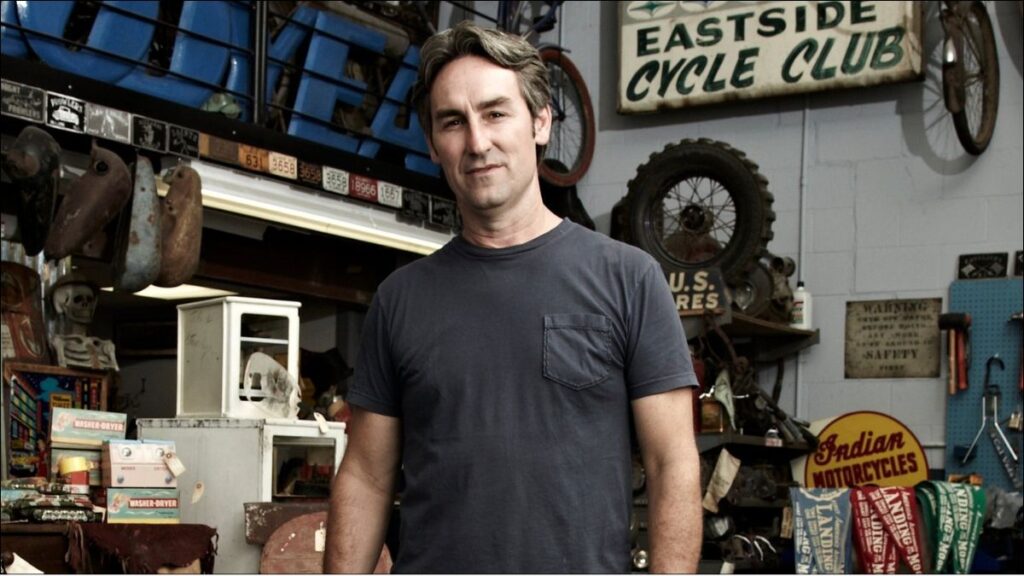
We live in an era that tends to favor the new over the old, the efficient over the beautiful, and the scalable over the particular. Big-box stores have hollowed out Main Streets. Algorithms optimize for engagement rather than meaning. Craft and tradition are treated as novelties rather than necessities.
Against that backdrop, the Mike Wolfe passion project feels not just admirable but urgently necessary.
Small towns across America are at a crossroads. They have history, character, and community bonds that no amount of urban development can manufacture from scratch. But they also face real economic pressures — population decline, lack of investment, and the slow erosion of the institutions that once held them together.
Wolfe’s approach offers a practical model: treat historic preservation not as a sentimental indulgence but as a genuine economic and cultural strategy. Restore what’s worth saving. Build businesses around authenticity. Attract people who are hungry for real stories in a world drowning in synthetic ones.
It works. Columbia, Tennessee is proof.
What We Can All Learn From Mike Wolfe’s Approach
You don’t have to be a TV personality with national reach to apply the lessons of the Mike Wolfe passion project. The principles scale.
1. Look at what others overlook.
Wolfe built his entire career on seeing value where others saw junk. That same instinct applies to communities, buildings, and traditions that have been written off as irrelevant.
2. Preservation is not passive.
Saving something doesn’t mean freezing it in time. It means finding a new way for it to be useful, meaningful, and alive in the present. The best preservation is also creation.
3. Story is infrastructure.
Before any building gets restored or any investment gets made, there has to be a compelling narrative — a reason people should care. Wolfe is a master storyteller, and that skill is inseparable from his ability to drive real-world change.
4. Community first, profit second.
The economic success of his projects follows from genuine community investment, not the other way around. When people feel that their history is being honored, they show up. They spend. They stay.
5. Small acts add up.
One building. One motorcycle. One interview with an aging craftsperson. The Mike Wolfe passion project is built from thousands of individual acts, each small on its own, collectively enormous in impact.
Conclusion
Mike Wolfe is, by his own description, just a guy who never stopped riding his bike through alleys looking for things worth saving. But the simplicity of that self-image belies the scale and significance of what he’s actually built.
The Mike Wolfe passion project is one of the most compelling examples in contemporary America of what it looks like to turn a personal passion into a public good. It’s a reminder that history isn’t something that lives only in textbooks and museums — it lives in buildings, in objects, in songs, in the hands of people who still know how to make things the old way.
And it lives in towns that, with the right kind of attention and investment, still have a future worth showing up for.
Frequently Asked Questions
What exactly is the Mike Wolfe passion project?
The Mike Wolfe passion project refers to Wolfe’s broader mission beyond American Pickers — a sustained effort to preserve America’s historic buildings, cultural traditions, and artisan craftsmanship through restoration, storytelling, and community investment.
Where has Mike Wolfe focused most of his preservation work?
Much of his most visible work has been concentrated in Columbia, Tennessee, where he developed Columbia Motor Alley and invested in multiple historic properties. He’s also active throughout Middle Tennessee as part of the Nashville’s Big Back Yard initiative.
What is Two Lanes, and how does it connect to his mission?
Two Lanes is Wolfe’s personal blog and online shop, where he documents forgotten places, artisan makers, and American craft traditions through photography, interviews, and editorial content. It’s a digital extension of his preservation philosophy.
Does Mike Wolfe have a non-profit or formal organization behind his passion project?
While Wolfe has operated various business ventures and community development projects, his passion project is largely pursued through private investment, personal advocacy, and his media platforms rather than a single formal nonprofit structure.
How can people support or get involved in the spirit of Mike Wolfe’s work?
You can follow Two Lanes, shop from artisan makers he spotlights, visit the communities he’s helped revitalize, and advocate locally for historic preservation in your own town. The mission scales — every community has something worth saving.
